Few things confuse people newer to investing as consistently as watching stock markets rise during a period when the economy, by most everyday measures, feels genuinely weak — job losses in the news, businesses struggling, consumer confidence down. It looks like a contradiction. It isn’t, once you understand that “the market” and “the economy” are related but genuinely different things, measuring different aspects of economic life on different timescales.
Markets price the future, the economy reports the present
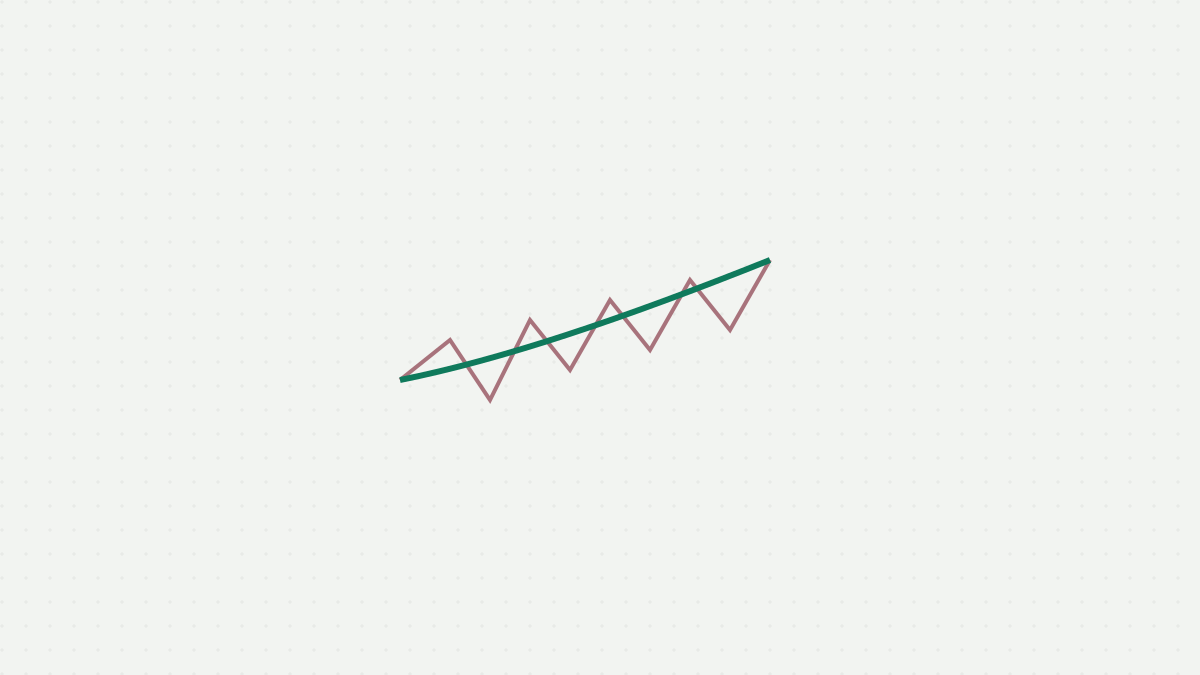
The single most important distinction is timing. Economic data — unemployment figures, GDP growth, retail sales — describes what has already happened, typically with some reporting lag on top of that. Stock markets, by contrast, are constantly pricing in expectations about company earnings months and years into the future. This means markets can rise not because current conditions are good, but because investors collectively expect conditions to improve from a currently weak starting point — the market moving ahead of the economy, not disconnected from it. This is genuinely one of the most well-documented patterns in market history: stock markets have often bottomed and begun recovering while unemployment and other backward-looking economic indicators were still deteriorating, because markets were already pricing in the eventual recovery before it showed up in the data.
The stock market isn’t the same thing as “the economy” in composition, either
Beyond timing, there’s a compositional gap worth understanding. A country’s stock market is dominated by its largest publicly listed companies, which is a meaningfully different population than “the economy” as a whole, which includes small businesses, self-employed workers, and sectors that may have little or no public-market representation at all. Large listed companies, particularly multinational ones, often generate a significant share of revenue from outside their home country, meaning their fortunes can diverge considerably from their domestic economy’s health. A national stock market index, in other words, is a reasonable proxy for large-company earnings expectations — not a direct read on how the broader economy or an average household is actually doing.
Interest rate policy adds another layer to this disconnect
Central bank interest rate decisions add a further complication, particularly relevant during periods of economic weakness. When an economy weakens, central banks often respond by cutting interest rates, or signalling they’re likely to. Lower interest rates tend to be genuinely positive for stock valuations, for reasons rooted in how future company earnings get valued in today’s terms, and for how attractive stocks look relative to lower-yielding alternatives like bonds and cash. This creates a real dynamic where weakening economic data can actually push markets higher in the short term, because investors interpret the weakness as increasing the likelihood of supportive rate cuts — the opposite of the naive expectation that bad economic news should straightforwardly produce falling markets.
Why this disconnect can feel genuinely uncomfortable, and reasonably so
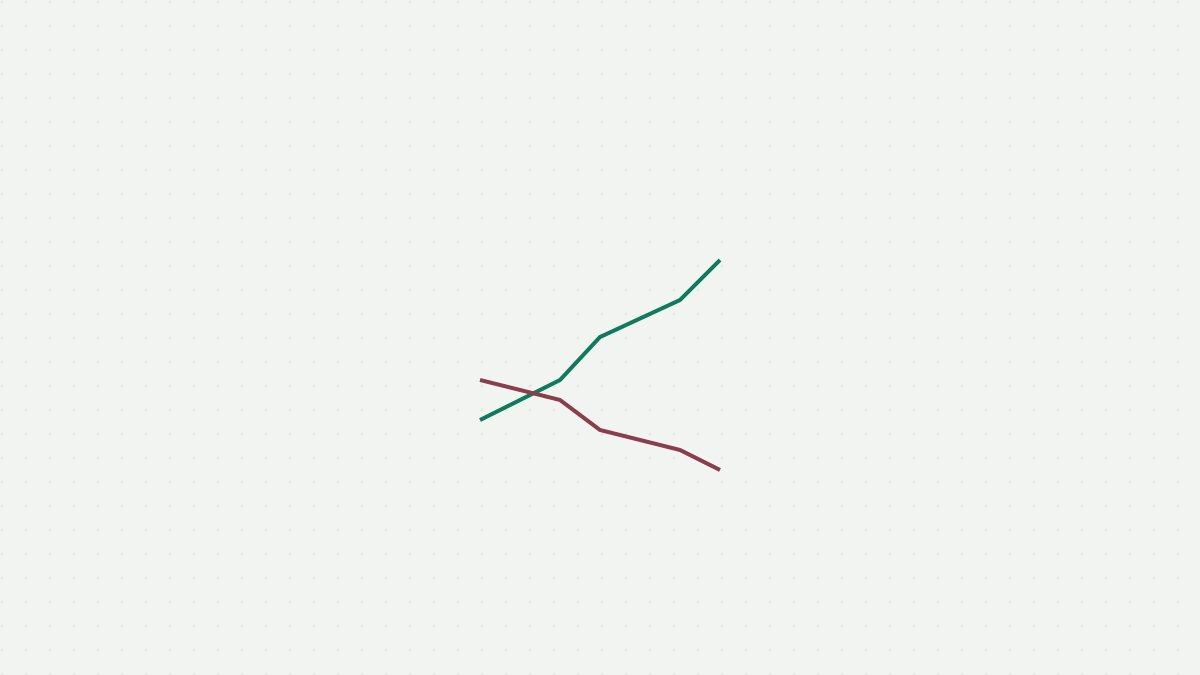
It’s worth acknowledging directly that this disconnect isn’t purely a matter of investor psychology being irrational — it reflects a genuine, uncomfortable reality: financial markets and the everyday economic experience of most people can move in different directions for extended periods, sometimes over a year or more. Someone experiencing genuine financial strain — job insecurity, rising costs — reading that markets are at record levels can reasonably find that dissonant, and dismissing that discomfort as simple misunderstanding understates a real and legitimate tension in how modern economies actually function, where asset ownership and everyday economic experience aren’t evenly distributed across the population.
What this means for how to read market and economic news together
The practical takeaway isn’t that economic data is irrelevant to markets — over the longer run, company earnings and market performance are genuinely connected to underlying economic activity. It’s that short-term market movements shouldn’t be read as a simple, real-time scorecard of how the economy is currently doing, in either direction. A rising market during weak economic data is often the market pricing in an expected future improvement, not evidence that current conditions are actually fine; equally, a falling market during strong economic data can reflect concern that current strength won’t be sustained, or that it will prompt less supportive policy responses.
Why this disconnect makes diversification more, not less, important
This gap between market pricing and current economic reality is itself a reason genuine diversification across asset classes and geographies matters, rather than trying to time a single market’s direction based on how the economy currently feels. If markets are pricing in expectations that can shift well before the underlying economic data catches up, an investor concentrated in a single market or asset class is making an implicit bet on correctly reading those expectations — a genuinely difficult thing to do consistently, and one diversification structurally reduces the need to get right.
How interest rate expectations get priced in before any actual decision
It’s worth being specific about how forward-looking this pricing actually is: markets don’t just react to central bank decisions once announced — they continuously price in the market’s collective expectation of future decisions, based on economic data, central bank communication, and other signals, well before any actual meeting takes place. This is why markets sometimes move relatively little on the day of an interest rate announcement that matched expectations, and sometimes move significantly on a decision that technically kept rates unchanged but included commentary that shifted expectations about future moves — the market was already pricing in the expected outcome, and reacting instead to the gap between expectation and reality.
What this article is not
This is a description of how markets and economic conditions generally relate to each other, not investment advice or a prediction about the direction of any market. Markets are influenced by many factors and can behave unpredictably over any given period; nothing here should be read as a signal to act on.
Sources: General financial market and macroeconomic education on the relationship between markets and the broader economy.