A sharp single-day market decline reliably produces dramatic headlines — the specific percentage, the dollar or point figure, language like “plunge” or “rout.” What those headlines reliably don’t convey as clearly is how ordinary a move of that size actually is in the broader context of how markets behave, and how weak the connection typically is between a single volatile day and anything meaningful about the underlying economy.
Volatility is a normal, measurable feature of markets, not a malfunction
Markets moving up or down by a percent or more on a given day isn’t a sign that something has gone wrong with the market as a mechanism — it’s simply what markets pricing in constantly updating, genuinely uncertain information look like on a day-to-day basis. Historical data on major stock indices shows that single-day moves of one percent or more occur with real regularity over any sufficiently long period, including during periods that, in hindsight, were part of extended overall upward trends. Volatility and decline aren’t the same thing, and treating any volatile day as inherently alarming conflates the two.
Why a single day rarely reflects a change in underlying fundamentals
The economic and business fundamentals that ultimately drive long-run market value — company earnings, broad economic growth, interest rates — don’t typically change meaningfully within a single trading day, even when prices move sharply. Single-day moves are far more often driven by shifts in short-term sentiment, positioning, or reaction to a specific news event than by any genuine, rapid change in the underlying fundamentals those prices are ultimately supposed to reflect. This is a meaningful distinction: a market reaction can be real and immediate while still reflecting something considerably more transient than the headline framing suggests.
Why headlines are structurally biased toward drama
It’s worth being direct about why volatility coverage skews toward alarm: a dramatic single-day move is more attention-grabbing, and therefore more commercially valuable to cover intensively, than the comparatively unremarkable fact that markets fluctuate constantly as a normal function of how they work. This isn’t necessarily a claim of bad faith on the part of financial media — it’s simply a structural incentive that exists regardless of intent, and it’s worth factoring in when deciding how much weight to put on any single day’s coverage of a market move.
What actually does tend to matter more than single-day moves
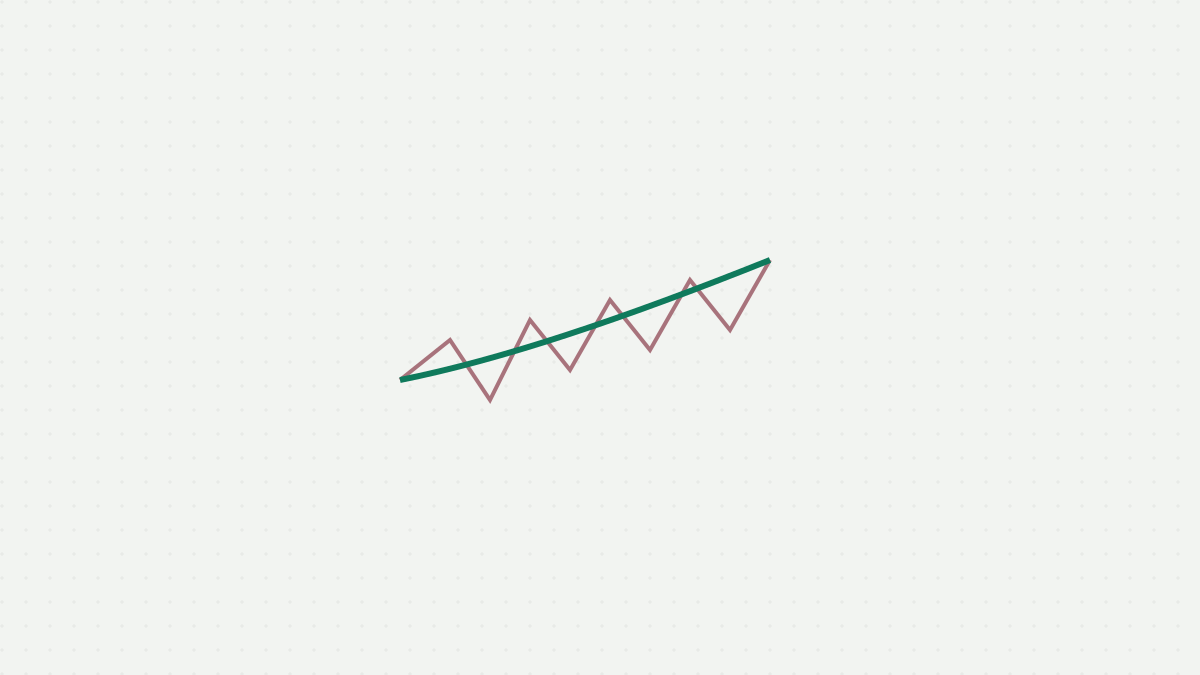
If single-day volatility is a poor signal on its own, sustained trends over meaningfully longer periods — measured in months or years rather than days — carry considerably more genuine information about underlying conditions, since they’re less likely to reflect a single transient event and more likely to reflect a real, sustained shift in fundamentals, sentiment, or economic conditions. This is a large part of why long-term investors are routinely advised to pay less attention to daily market movements: not because daily information is meaningless, but because it’s an unreliable, high-noise signal relative to what it’s often assumed to represent.
How this connects to why markets can rise despite a weak economy
This same distinction between short-term noise and underlying signal helps explain a related pattern worth understanding: markets can rise even when current economic conditions feel weak, because markets are pricing in expectations about the future, not simply reacting to present conditions — a dynamic that operates on a considerably longer timescale than any single day’s volatility.
Why this doesn’t mean volatility never carries real information
None of this is an argument that volatility is always meaningless or should always be ignored. Sustained, unusually elevated volatility over an extended period can genuinely reflect real uncertainty about future conditions, and some sharp single-day moves do coincide with genuinely significant news. The point isn’t that volatility never matters — it’s that a single volatile day, considered in isolation and without further context, is a weak and unreliable signal on its own, regardless of how dramatically it’s covered.
Why reacting to single-day moves tends to backfire
A well-documented pattern in investor behaviour is that reacting emotionally to short-term volatility — selling during a sharp decline, for instance — tends to lock in a loss that a genuinely long-term holding period would often have had time to recover from, assuming the underlying investment thesis hadn’t actually changed. This isn’t a guarantee about any specific investment or market recovering from any specific decline, but it’s a well-established behavioural pattern worth being aware of before treating any single day’s headline as a reason to act.
What this article is not
This is a general explanation of market volatility, not investment advice or a prediction about any specific market’s future direction. Markets can and do decline over sustained periods as well as single days, and this isn’t personalised financial guidance.
Sources: General market data on historical volatility patterns in major stock indices, and financial journalism and academic research on investor behavioural responses to short-term market moves.