An annual investment fee of one percent sounds small enough to dismiss — smaller than most people’s grocery budget variance from month to month. Compounded against decades of investment growth, that same one percent is considerably more consequential than its headline size suggests, and the reason has less to do with the fee itself than with what that fee prevents from happening over time.
The mechanism, stated precisely
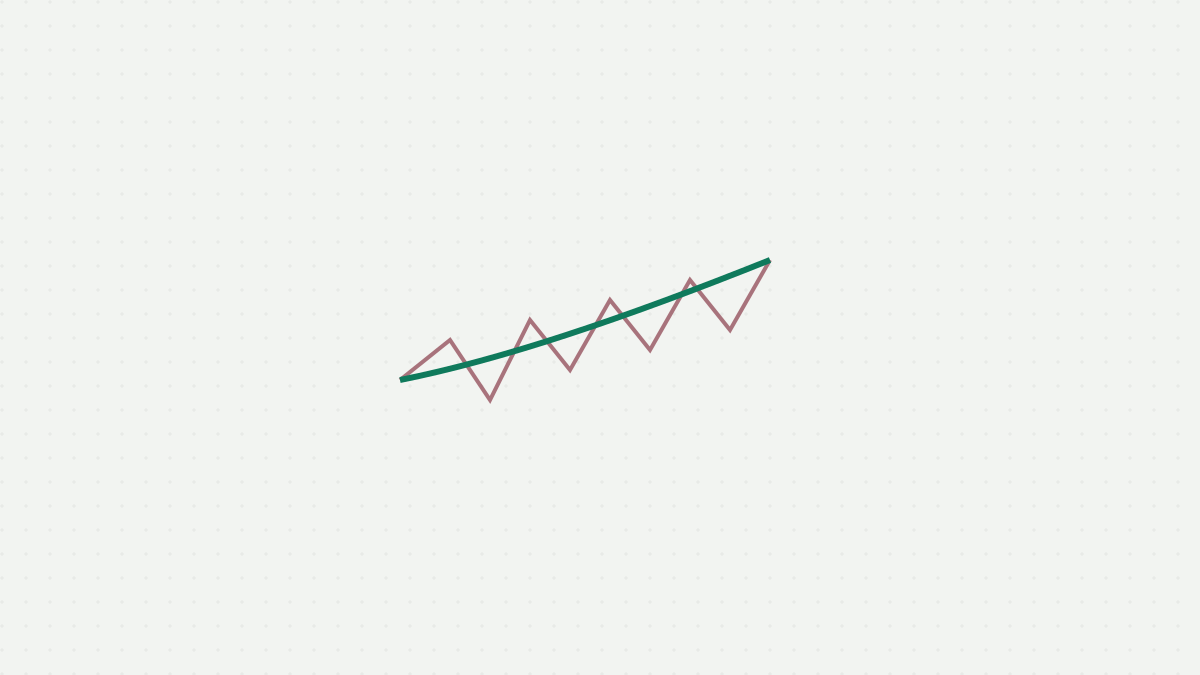
A fee doesn’t just reduce returns in the year it’s charged — it reduces the base amount available to compound in every subsequent year, and that lost compounding is the real cost, not the fee itself. A one percent annual fee charged over several decades doesn’t cost one percent of the final value; it costs considerably more, because the amount the fee removed each year would otherwise have continued compounding alongside the rest of the investment for every year remaining in the holding period. This is the same multiplicative mechanism that makes compound growth powerful in the first place, simply working against the investor rather than for them.
Why the effect grows with time horizon, not shrinks
Because the fee’s real cost comes from lost compounding rather than the direct deduction, its impact grows the longer money stays invested — precisely the opposite of what intuition suggests about a “small, fixed” annual cost. A fee charged over five years costs meaningfully less, in compounding terms, than the identical percentage fee charged over thirty years, even though the annual rate never changed. This means fees matter disproportionately for exactly the kind of long-horizon investing — retirement savings being the clearest example — that most individual investors are actually doing, which is also where the effect is hardest to notice year to year, since any single year’s fee deduction looks modest in isolation.
Why comparing fees in isolation misses the real question
The more useful comparison isn’t whether a specific fee sounds reasonable on its own, but what that fee is actually buying relative to lower-cost alternatives available for similar underlying exposure. Actively managed funds, which aim to outperform a market benchmark through security selection, typically charge higher fees than passively managed funds tracking a benchmark index, and a large and long-running body of research on fund performance has found that a majority of actively managed funds underperform their relevant benchmark over most extended periods, after fees are accounted for — though performance varies by fund, asset class, and time period, and past results don’t guarantee future ones.
Why “the fee is worth it if the fund beats the market” undersells the bar
Even setting aside average outperformance rates, there’s a structural point worth making clearly: a higher-fee fund doesn’t just need to outperform a comparable lower-fee alternative before fees — it needs to outperform by more than the fee difference itself, every single year, for the higher fee to have actually been worthwhile net of cost. This is a considerably higher bar than “did the fund manager make good decisions,” and it’s the specific bar that a large share of actively managed funds fail to clear consistently over long periods, based on available published performance research.
What actually varies across common fee structures
Investment costs show up in different forms beyond a headline expense ratio — trading costs within a fund, account or platform administration fees, and in some cases entry or exit charges — and comparing investments on expense ratio alone can miss meaningful cost differences elsewhere in the total structure. A genuinely useful fee comparison looks at total ongoing cost across all these components, not just the single most visible number typically advertised.
Why this isn’t an argument against paying for anything
None of this is a blanket argument that lower fees are always the right choice regardless of context, or that professional management or advice is never worth paying for. Some investors reasonably value professional guidance, specific strategies, or services beyond pure investment selection, and are making an informed trade-off in choosing to pay more for them. The point isn’t that fees are inherently wrong — it’s that their true long-term cost is easy to underestimate, and any fee should be weighed against that true cost, not against its comparatively modest-looking headline percentage.
Why this connects to diversification too
Fee awareness sits alongside, rather than instead of, other core investing principles — understanding what diversification is actually protecting against remains just as relevant regardless of what an investor pays in fees, since a low-fee but poorly diversified portfolio carries risks that cost minimisation alone doesn’t address.
What this article is not
This is a general explanation of how investment fees affect long-term returns, not a recommendation regarding any specific fund, provider, or fee structure. Whether a given fee is reasonable depends on what it’s paying for and an individual’s own circumstances; this isn’t personalised financial or investment advice.
Sources: General investing education and published research on fund fee structures and long-term active-versus-passive fund performance comparisons.